
Updated October 2026.
Medically reviewed by Dr. Kwangsuk Suh, board-certified dermatologist.
XERF is one of the newer names in non-surgical skin tightening, developed in Korea and increasingly asked about by international patients. It is a radiofrequency treatment designed to tighten and lift the skin’s structure, deeply, but without needles, numbing, or real downtime.
This guide explains what an XERF treatment is, how it works, and who it suits. It is written for international patients, and our coordinators can help with appointment questions.
What XERF Is
XERF is a monopolar radiofrequency device used at Dr. E-Laser Dermatology for structural skin tightening. What sets it apart is its use of two frequencies together: one working nearer the surface and one reaching deeper, towards the SMAS-like layer that a surgeon addresses in a facelift. It also measures the skin’s depth and adjusts the energy accordingly, so the treatment is tailored as it goes.
How It Works
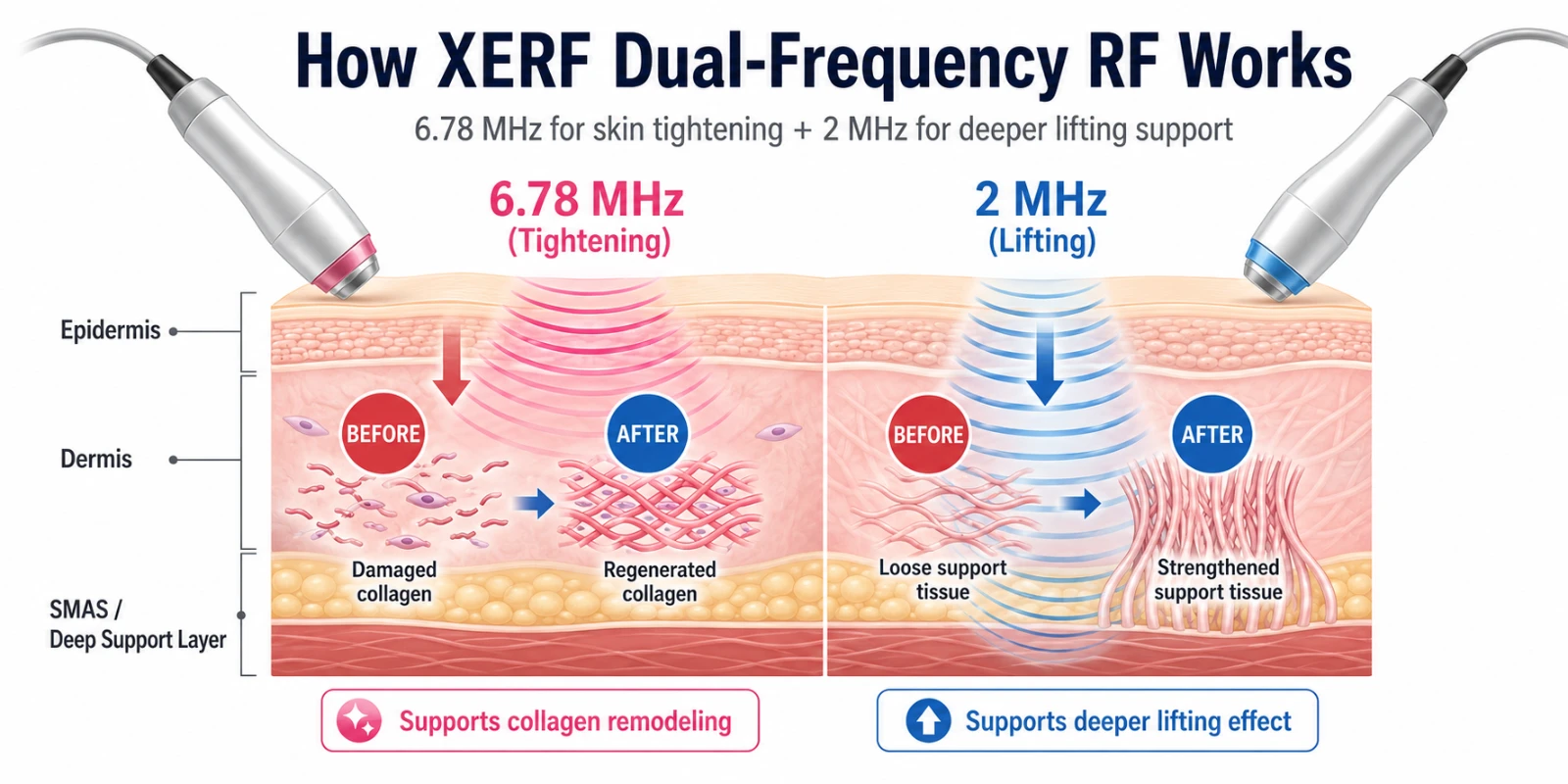
Like other radiofrequency tightening, XERF heats the deeper skin in a controlled way. That heat contracts existing collagen for some immediate firming and stimulates the skin to produce new collagen and elastin over the following months. Because it reaches a deeper, more structural layer, an XERF treatment is aimed at lifting the framework of the skin rather than only refining the surface.
What a Session Is Like
An XERF session usually takes around 45 to 60 minutes, with integrated cooling that keeps it comfortable, most patients need no numbing and describe it as a warming sensation. There are no needles and no incisions. Downtime is minimal, with at most mild redness or warmth that settles quickly, so most people return to normal activity the same day.
Who It Suits, and Who It Does Not
XERF skin tightening suits people with mild to moderate laxity who want structural firming without surgery or recovery time: early softening along the jawline, a less defined lower face, or skin that has started to feel looser after weight change or with age. Because the energy is delivered to deeper layers with depth and temperature monitored during treatment, it is a reasonable option when the concern is the skin’s framework rather than its surface.
It suits less well people with significant, heavy sagging, where a non-invasive device is unlikely to do what surgery does, and we would rather say so at the consultation. As with other monopolar radiofrequency treatments, it is generally not performed over active skin infection or open lesions, during pregnancy, or for people with implanted electronic devices. Metal implants and fillers in the treatment area are assessed case by case. The doctor confirms suitability in person, and the answer is sometimes a different device or a combination.
XERF for Sensitive Skin and Early Laxity: How the Depth Modes Are Used
XERF is often the device discussed for patients who want structural firming but have skin that reacts easily to heat. The reason is in how the energy is controlled. The two frequencies, 6.78 MHz and 2 MHz, cover the range from the superficial layers to the subcutaneous tissue, and the doctor selects one of three depth modes and one of ten energy levels for each area rather than running a single setting across the face. Surface temperature is monitored throughout, so energy output is held steady without excess heating of the skin surface.
At Dr. E-Laser Dermatology that control is used for cheek laxity, early fine lines and texture, and for patients who are beginning to notice volume loss and prefer a lower-heat approach. Because the heating is electrical rather than light-based, skin tone does not rule it out, which is covered in the FAQ below. It is also one of the devices planned for ongoing maintenance, with the interval set at consultation from how your skin responds rather than by a fixed calendar.
How It Compares
XERF sits alongside other tightening technologies, ultrasound (Ultherapy), other radiofrequency (Thermage), and laser (titanium lifting). Each reaches a slightly different depth and suits different skin. Our non-surgical skin tightening guide explains the differences, and a doctor will match the right device, or combination, to your face.
How Many Sessions, and When Results Show
XERF is typically planned as a course whose length depends on the areas treated and how your skin responds, with the option of maintenance later. The doctor sets the plan and any interval at the consultation rather than by a fixed calendar. Some people notice a degree of firming on the day, and some do not. The fuller change develops gradually over the following months as new collagen forms, and the degree varies between individuals.
XERF vs Thermage: what actually differs
Both are monopolar radiofrequency, and both work by heating the deeper skin to contract existing collagen and stimulate new collagen. The practical differences are in how the energy is controlled. XERF uses two frequencies together, 6.78 MHz and 2 MHz, with three depth modes, and monitors skin temperature and depth in real time during treatment. Thermage FLX uses a single frequency with its own tuning and vibration system. Which suits you is a question of skin thickness, the area, and the doctor’s assessment, not of one device being better than the other. Our Thermage in Seoul guide and Ultherapy in Seoul guide explain the other options in the same family, and our guide on combining skin treatments covers how a doctor sequences more than one.
Curious whether XERF suits your skin? Share a photo and our English-speaking coordinators will help you plan. Speak with us on WhatsApp.
XERF at Dr. E-Laser Dermatology
Dr. E-Laser Dermatology is a laser-focused dermatology practice in Cheongdam, Seoul, one minute from Apgujeong Rodeo Station. With a device like XERF, the doctor-led value is in reading your skin and setting the treatment to it, rather than applying a fixed protocol to everyone.
Our coordinators and staff support you in English, from the first message through the consultation with the doctor to aftercare. Our guide to finding an English-speaking dermatologist in Seoul explains the wider process. Enquiries can be made on WhatsApp.
Pricing and Consultation
Because a plan depends on the areas treated and the sessions needed, pricing is shared during your consultation rather than as a single fixed figure.
Frequently Asked Questions
What is XERF treatment?
A non-invasive monopolar radiofrequency treatment used for structural skin tightening. It uses two frequencies to firm the skin at both surface and deeper, SMAS-like levels, stimulating collagen for a gradual lift.
Does XERF hurt, and is there downtime?
Integrated cooling keeps it comfortable, and most patients need no numbing and no needles. Downtime is minimal, brief redness or warmth that settles quickly.
When will I see results?
There is often some immediate firming, with the fuller result developing over the following months as new collagen forms.
How is XERF different from Thermage?
Both are radiofrequency, but XERF uses dual frequencies and depth measurement to reach a deeper, more structural layer. The right choice depends on your skin, and a doctor will advise.
Is support available in English?
Yes. Our English-speaking coordinators support you from the first message through the consultation to aftercare, and you are welcome to message us on WhatsApp beforehand.
Can XERF be combined with Ultherapy or a skin booster?
Sometimes, and in a specific order. Energy devices are usually spaced rather than stacked on the same day, and boosters are timed around them. Whether a combination makes sense, and in what sequence, is decided by the doctor after seeing your skin.
Is XERF suitable for darker or tanned skin?
Radiofrequency heats tissue through electrical energy rather than light, so it does not target pigment the way some lasers do. That means it is not ruled out by skin tone, though suitability is still judged in person for each patient. Our guide on laser treatment for darker skin explains where the light-based caveats apply.
About the Doctor
Dr. Kwangsuk Suh is a board-certified dermatologist and the medical director of Dr. E-Laser Dermatology. He is an adjunct clinical professor of dermatology at Kyung Hee University and Sungkyunkwan University colleges of medicine, and an active member of the Korean Association of Dermatologists, the Korean Association of Clinical Dermatologists, the Korean Society of Hair Restoration Surgery, and the Korean Society for Dermatologic and Cosmetic Surgery.
Arrange a Consultation
If you would like to know whether an XERF treatment suits your skin, we are glad to help. Share a photo, ask anything, and our English-speaking coordinators will arrange a private consultation. Speak with us on WhatsApp.
This article is for general information and is not medical advice. Outcomes vary between individuals, and a diagnosis and treatment plan are confirmed during an in-person consultation.
Medically reviewed by Dr. Kwangsuk Suh, board-certified dermatologist.
To see how this is done at our clinic, read more about XERF lifting at Dr. E-Laser.