
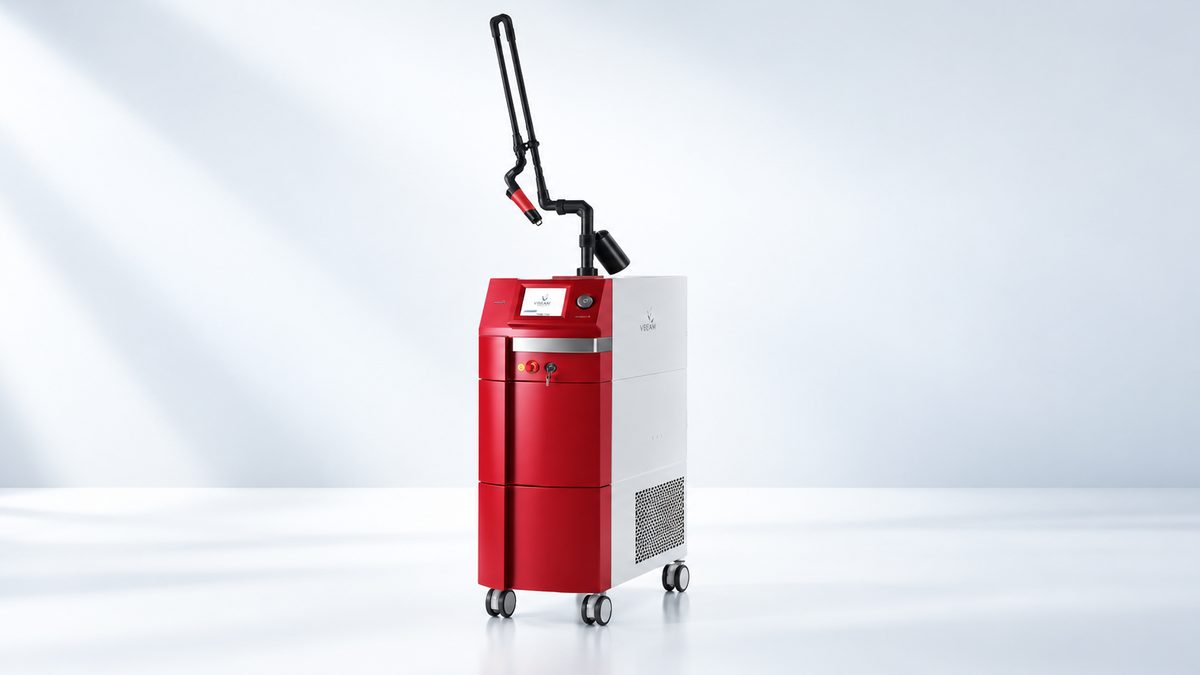
Not all pigment sits at the same depth, and depth is one reason a mark on your face can respond to treatment while the one beside it does not. This page is for English-speaking residents in Seoul who are looking specifically at pigment that has stayed put, and who want to understand what a ruby laser is for before booking anything. It covers what the wavelength does, which kinds of pigment it is generally used for, and what a session at Dr. E-Laser™ involves.
What the ruby laser does
The ruby laser is named after its source. The light is generated in a synthetic ruby crystal, and that crystal emits at 694 nm. That number is most of the reason the device exists as a separate tool in a clinic that already has other pigment lasers.
Melanin absorbs light at 694 nm strongly. Longer wavelengths also scatter less on the way through the skin than shorter ones do, so more of the energy arrives at depth and less of it is spent in the upper layers. Put those two properties together and you get a wavelength matched to pigment that sits in the dermis, below the surface layers.
That is the practical point for anyone who has already had pigment treated without much change. A mark that has not shifted is not necessarily a sign that the earlier treatment was wrong. It can simply mean the pigment was sitting deeper than the light being used was reaching. Depth is only one of the variables, though. The type of pigment matters just as much, and telling one type from another is done by examination, not from a photograph. Our overview of pigment types sets out how they are distinguished.
Which pigment types this suits
Broadly, the ruby laser is used where the pigment is understood to be dermal: colour held below the epidermis, often reading as grey, blue grey or brown grey, where a surface mark reads as a crisp brown. Marks of that kind tend to be bilateral or patterned, not scattered, and they usually have a longer history than a spot that appeared last summer.
Whether your own marks belong in that group is a clinical decision. Two conditions that look similar in a mirror can sit at different depths and can respond very differently to the same wavelength, which is why the assessment comes before any talk of settings. If your concern is small surface marks across the cheeks and nose and not a deeper patch, how freckles are assessed is a closer starting point than this page.
Skin tone is part of the same assessment. The light that targets a mark is also absorbed by the melanin in the surrounding skin, so tone is part of how a pigment laser is planned for any patient. Suitability for your skin is confirmed in person at the clinic, and it is not something to settle from a device name or from what worked for someone else. Anyone with a history of pigment darkening after inflammation, injury or a previous treatment should say so at the consultation, because it changes the plan.
If you want to describe your own marks and ask whether this is the right direction before you book, you can message the clinic. Speak with us on WhatsApp.
What a session involves
At Dr. E-Laser, ruby laser is scheduled as a single session. What happens after the first appointment is decided from how your skin actually responded.
The appointment starts with examination under clinic lighting, which shows pigment that a phone camera flattens out. The examination is establishing two things: what the pigment is, and where it sits. Those answers, not the calendar, determine whether the ruby laser is used at all.
The treatment itself is short and local to the marked area, and eye protection is used during the laser part of the appointment.
A numbing cream is applied before the session. Each pulse is often described as feeling like the snap of a rubber band, the setting is adjusted to the pigment and the skin type as the session proceeds, and the laser work for a few spots is a matter of minutes, so the visit is commonly under half an hour.
A few things are worth raising at the consultation itself. Any medication you take, particularly anything that increases sensitivity to light, affects the plan. So does recent sun exposure, since skin that has tanned recently is not a stable starting point for a pigment laser. Recent treatments in the same area, pregnancy and breastfeeding should also be mentioned at the consultation. None of these automatically rules treatment out, but each one can change the timing.
DermNet, the dermatology reference, describes satisfactory clearing of pigmented lesions after around 1 to 6 ruby laser sessions, repeated about every 8 weeks. How many you need depends on the depth of the pigment and is set at the consultation.
The clinic’s melasma page describes the device as a Q-switched ruby laser working at 694 nm.
What to expect afterwards
Pigment lasers do not clear a mark on the day. The usual pattern is that treated pigment looks more obvious for a short period, and some redness or a fine crust over the treated points is a normal part of that sequence, not a sign that something went wrong. How the pigment itself settles differs between individuals and is reviewed at follow-up.
Two habits matter in the weeks that follow. Leave the treated area alone: no picking at any crust, no scrubs and no additional treatments on the same skin without checking first. Then sun protection, which is not a summer measure in Seoul but a year round one, and which matters more after a pigment treatment than before it.
The clinic’s published aftercare guidance for its pigment lasers notes warmth, redness and swelling at the treated area for up to 2 to 3 days, pinpoint bruising for 3 to 7 days where deeper pigment is treated, a crust that should be left to come away on its own, dryness that calls for moisturiser rather than scrubs, and sunscreen whenever outdoors. Alcohol, smoking, saunas and strenuous exercise are avoided for about a week.
Pigment can also darken again after treatment in some people, which is one of the reasons the clinic wants to see how your skin responded before planning further sessions. Individual responses vary, and the plan is adjusted accordingly. If anything in the treated area concerns you at any point, contact the clinic without waiting for the next appointment.
Booking a consultation
Dr. E-Laser is a doctor-led clinic in Seoul. For pigment, a consultation is genuinely the useful part: it establishes what the marks are, whether 694 nm is the right wavelength for them, and whether anything should be treated before the pigment itself.
English-speaking coordinators support communication, scheduling and aftercare instructions throughout your visit, and messages are answered Monday to Friday from 10:30 to 19:30 and on Saturday from 10:30 to 16:30, Korea time.
We are in Cheongdam, Seoul, one minute on foot from Apgujeong Rodeo Station Exit 4.
If you are already in Seoul and want to ask about pigment that has not responded so far, message the clinic. Speak with us on WhatsApp.
Frequently asked questions
What wavelength does a ruby laser use?
694 nm. The light is produced in a synthetic ruby crystal, and that emission wavelength is fixed by the crystal itself, so it is the same for any ruby laser.
What does Q-switched mean?
Q-switching is a general laser engineering term. It describes a way of storing energy in the laser and releasing it in very short pulses, which is the approach normally used when pigment is the target. Which pulse mode is appropriate for your case is confirmed at the consultation.
Can the ruby laser be used on my skin tone?
That is assessed in person. Melanin in the surrounding skin absorbs the same light as the pigment being targeted, so skin tone is part of how any pigment treatment is planned. It is confirmed in person at the consultation, not decided in advance.
How many sessions will I need?
This is set after examination and after seeing how your skin responded to the first session, so the number is not decided before treatment begins.
I have been in the sun recently. Does that matter?
Tell the clinic. Recently tanned skin changes how a pigment laser behaves, and the clinic may prefer to wait before treating.