
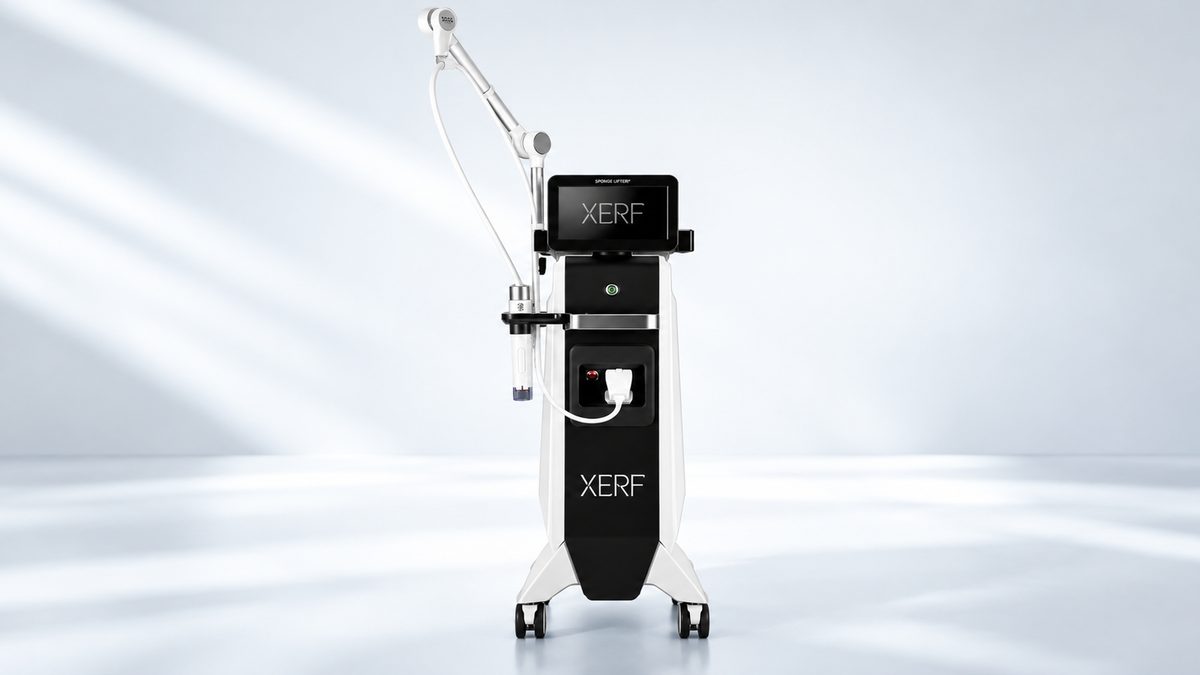
If you have already settled on XERF, the next question is usually a number. At Dr. E-Laser™, XERF is booked in two shot counts, 300 and 600, and most people arrive at the consultation unsure which one applies to them. This page is written for English-speaking residents in Seoul who want to understand how that number gets set before they sit down for it.
What XERF does
At Dr. E-Laser, XERF is offered in two shot counts, 300 and 600. Both use the same system. What changes between them is how much of the treatment is planned into one visit.
XERF is a monopolar radiofrequency system made by Cynosure Lutronic. The manufacturer describes it as combining 6.78 MHz and 2 MHz frequencies, with three depth settings and ten intensity levels, and a cooling system that holds the surface temperature while energy is delivered below it. The clinic’s XERF lifting in Korea page adds that skin thickness and surface temperature are monitored in real time during treatment.
Shot count is not a tier, in the sense of a basic option and a premium one. It describes scope: how much ground a single session is set up to cover.
If you have not yet read the background on the device itself, our guide to what XERF is covers the mechanism and the general candidacy questions. This page stays on the number.
How shot count is decided
Two things drive it.
Area matters because the shots are distributed across whatever zone is being treated, so a plan that covers the lower face and jawline is not set up the same way as one that also takes in the cheeks, the temples and the neck. Which count applies to your plan is decided at the consultation rather than from the area alone.
What the clinic reads in your skin on the day is the other input.
Because of that, the number is set in person. It is not something to lock in from a list beforehand, and a plan that was right for someone else’s face is not evidence about yours.
There is one assumption worth putting aside before the consultation. It is tempting to read the two options as a small treatment and a double-sized one, and to work out from there whether two of the smaller sessions would add up to the larger. Shot count per visit and the number of visits are two separate parts of the plan, and they are set together, not traded off against each other. If that is the calculation you are running, bring it up directly and have it answered for your case at the consultation.
Questions that are worth asking at the consultation, if you want to come prepared:
- Which specific areas is this count covering, and which are left out
- Whether the plan is one session or a course, and on what basis
- What would change the recommendation if you came back in a year
The clinic’s XERF page describes energy being regulated according to tissue depth, with the surface temperature monitored throughout the session.
This page suits you if you have already narrowed down to XERF and are trying to plan time and expectations around it. It is less useful if you are still at the stage of working out which tightening approach fits your concern at all, in which case our overview of non-surgical skin tightening options is the better place to start.
If you want a sense of which range your concern is likely to fall into before you come in, you can ask us first.
What a session involves
Nothing about the shot count changes which system is used. The count is about how much is delivered in the appointment.
Because there is more to deliver, the higher count takes longer in the chair. The exact length is confirmed when you book, since it also depends on which areas are included.
A retrospective evaluation of XERF in 16 patients, published in Lasers in Medical Science in 2026, treated the full face with 600 shots in a single session and reported mild, transient reactions: redness lasting one or two days in two patients, and redness with mild swelling that settled within a day in a third. Clinics using the device commonly describe a session as taking 30 to 60 minutes depending on the areas and the shot count, and plan one or two sessions a year. How long yours takes, and when a further session makes sense, are confirmed when you book.
What to expect afterwards
Because the treatment delivers energy into the skin, some reaction in the treated area afterwards is possible. What that looks like and how long it lasts is confirmed for you at the clinic, and it is not something to assume from someone else’s account.
Aftercare instructions are given to you at the clinic, and you can ask follow-up questions afterwards. If something about the treated area concerns you in the days that follow, contact the clinic at the time instead of waiting for a scheduled appointment to come around.
The clinic’s published aftercare guidance for its lifting treatments, which names XERF alongside Ultherapy and Thermage, describes swelling that can begin the day after treatment and usually lasts about 3 days, with mild swelling persisting for up to 14 days depending on recovery, and temporary discomfort around the mouth and eyes, including a tender or bruised sensation when the area is pressed or washed. It notes that a faint mark from the treatment tip can appear and settles within days, and that the effect appears gradually from about 4 weeks. On the treatment day, cleansing, makeup, saunas and jjimjilbang are avoided. Alcohol, smoking, saunas and strenuous exercise are avoided for about a week, sunscreen is applied outdoors, and the area is not massaged. If you have had dental root canal treatment within the past month, the guidance suggests waiting a month, because discomfort can be greater. The interval between sessions is set at the consultation.
One thing shot count does not do is set the outcome. A higher number describes a larger planned delivery in a single visit. It is not a statement about how your skin will respond, and responses differ between individuals.
Booking a consultation
The shot count is settled at the consultation. It helps to come with the area you are actually concerned about in mind, and to mention any previous tightening treatments you have had, since that feeds into the plan. Bringing the rough dates of those earlier treatments is more useful than the names alone.
It also helps to say what you want out of the session in your own words, not in device terms. The areas you point to are what the plan gets built around, and they are what the shot count follows from.
We are in Cheongdam, Seoul, one minute on foot from Apgujeong Rodeo Station Exit 4.
English-speaking coordinators support communication, scheduling and aftercare instructions throughout your visit, and messages are answered Monday to Friday from 10:30 to 19:30 and on Saturday from 10:30 to 16:30, Korea time.
If you are already in Seoul and want to ask about XERF before booking anything, send us a message.
Frequently asked questions
How many shots is XERF offered in at Dr. E-Laser?
Two counts: 300 shots and 600 shots.
What decides whether my session is planned at 300 or 600 shots?
Mainly how much area is being treated, together with what the clinic reads in your skin at the consultation. It is set in person, not picked in advance.
Does a higher shot count mean a stronger result?
No. Shot count describes how much is planned for a single visit. Responses differ between individuals.
Would two sessions at the lower count do the same job as one at the higher count?
That is a plan question, not an arithmetic one. How much is delivered in a visit and how many visits are scheduled are decided together, so ask at the consultation for the areas you want treated.