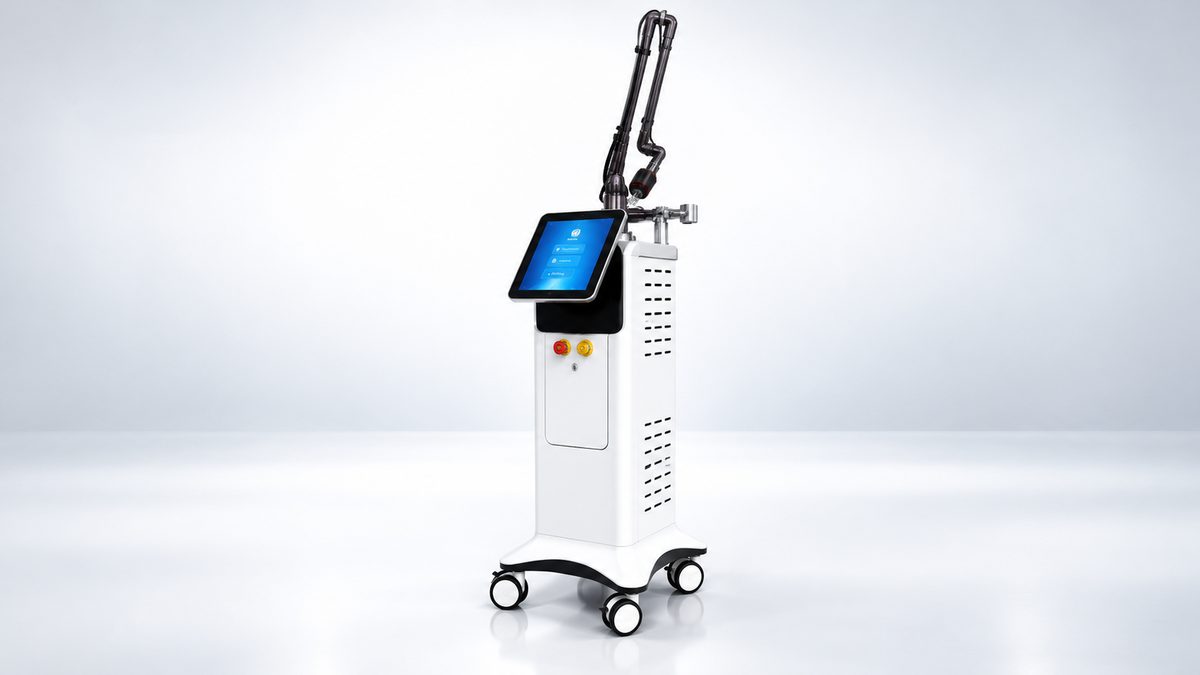
If you have a raised mole that keeps catching on a razor or a collar, or a run of skin tags along the neck, the question is usually a practical one: what does removal actually involve, and how is the spot checked before anything is done to it. This post covers CO2 laser removal at Dr. E-Laser, written for English-speaking residents in Seoul. It sets out what the laser does, who the treatment suits, how a session runs, and what the days afterwards look like.
What a CO2 laser does
A CO2 laser emits at 10,600 nm. That wavelength sits in the infrared range, where water absorbs light strongly. Skin is mostly water, so the beam gives up its energy in a thin layer at the surface and does not travel far into the tissue.
In practice, the laser takes a raised lesion off in fine passes. It is worked down in increments and stopped once the level of the surrounding skin is reached. That is what makes CO2 the tool reached for with raised, benign-looking lesions: common moles that sit above the skin line, skin tags, and small seborrheic keratoses. Its target is the physical bulk of a lesion. Pigment on its own is outside what it does.
That scope matters, because it sets what this post can be useful for. CO2 is for lesions with physical height. A flat mark that sits level with the skin around it calls for a separate assessment, and this post does not cover it.
Who this suits
CO2 removal is usually considered for:
- raised moles that catch on a razor, a collar, or a necklace
- skin tags, most often on the neck, the underarms, or around the eye area
- small raised bumps that are cosmetically bothersome but unremarkable on examination
The screening step matters more than the laser. A lesion is examined at the clinic before any device is switched on, and this is not a formality. CO2 removal vaporizes the tissue it treats. Once a lesion has gone straight to the laser, there is nothing left for a pathologist to look at.
If a spot looks atypical, has changed in shape, color, or size, bleeds without being knocked, itches persistently, or first appeared in adulthood, the assessment comes first and a biopsy is recommended where it is indicated. That decision is made in person at the consultation. A photograph is not enough to make it.
The location of a lesion shapes the plan too. Skin on the face settles differently from skin on the back or the chest. A spot in a fold, along a shaving line, or under a strap or a waistband heals under daily friction. None of that rules treatment out, but it does change what is sensible to treat in one sitting and what is better left for a second visit. That is one reason the count is decided at the consultation and not by message beforehand.
If you are not sure which of these applies to a spot, book the assessment. Speak with us on WhatsApp.
What a session involves
The session starts with a consultation. If you have not been to a Korean clinic before, what a first visit looks like walks through registration and the consultation itself, so that the paperwork is not the surprising part.
CO2 laser is charged per spot at Dr. E-Laser, not per session. That is worth knowing before you arrive, because it is the count of lesions, rather than the length of the appointment, that the plan is built around. It helps to note every spot you want looked at before the consultation.
The examination can also take the appointment somewhere other than the laser. If a spot looks like one that should be sampled instead of vaporized, no laser is used on it that day, and the next step for that spot is explained at the consultation. The screening step exists to catch that case, so it helps to go in thinking of the visit as an assessment that may lead to treatment, instead of a removal you have already booked.
The area is cleaned, the lesion is numbed, and the laser is worked in passes until the raised tissue is level with the skin around it. You will hear a faint crackle and may notice the smell of treated tissue during the passes. Both are expected.
The laser work itself takes a few minutes per lesion, so a visit commonly runs 15 to 30 minutes depending on how many spots are planned. Yours is confirmed when you book.
A numbing cream is applied before the laser is used, and the wait before treatment starts is confirmed at the consultation.
The site is dressed before you leave.
The clinic’s published aftercare guidance for CO2 laser is specific on the next steps. A regeneration tape is kept over the site for 7 to 10 days and changed every 3 days, without pulling it off. Cleansing can start the day after the procedure. Exfoliants, scrubs, swimming pools and saunas are avoided for at least 4 weeks, and the area is not massaged or rubbed.
What to expect afterwards
Each treated spot leaves a shallow open wound that sits slightly below the surrounding skin. It crusts over, the crust lifts on its own, and the new skin underneath is pink at first. How that pink settles varies between people, and it is one of the things looked at when the site is reviewed. Picking a crust off early is a common way to turn a clean result into a mark, so leave it to come away by itself.
Plan for sun exposure. New skin on a treated spot darkens easily under UV, and how likely pigmentation is afterwards differs by skin type. That is assessed at the consultation. Sunscreen over the site, once the clinic clears you to apply anything to it, is the practical control.
Not every lesion is finished in one pass. Deeper lesions are sometimes taken in stages so the level is not overcut, and a spot can recur and need a second visit. That is a normal course and does not mean the session failed. Whether a second visit is needed is judged at review, and it is hard to judge from home. Scarring is possible, as with anything that opens the skin surface, and it is one of the things weighed at the consultation before a given spot is treated.
The same aftercare guidance notes that a crust, redness or a faint laser mark can remain visible for up to 6 months, that intense itching during healing is expected and is a reason to contact the clinic if it is hard to bear, and that where a second session is needed it is scheduled after about two months.
One more set of questions is better settled at the clinic than guessed at, because the answer moves with where the spot is. Before you walk out, ask when makeup can go over the site, when you can shave across it, when swimming pools, public baths and saunas are back on, and when you can go back to exercise hard enough to leave you sweating. Ask while the dressing is going on and you will not need to call back.
Booking a consultation
A CO2 session is decided in person: what the spot is, whether it should go to a laser at all, and how many spots to plan for one sitting. If you are still deciding where to go, choosing a clinic sets out what to check before you book anything.
We are in Cheongdam, Seoul, one minute on foot from Apgujeong Rodeo Station Exit 4. English-speaking coordinators support communication, scheduling and aftercare instructions throughout your visit, and messages are answered Monday to Friday from 10:30 to 19:30 and on Saturday from 10:30 to 16:30, Korea time. If you are already in Seoul, you can ask about a consultation on WhatsApp.
Frequently asked questions
Can any mole be removed with a CO2 laser?
No. A mole is examined first, and some lesions should not go to a laser at all. If a spot looks atypical or has changed, a biopsy is recommended so the tissue can be read by a pathologist. Laser removal vaporizes the lesion and closes off that option, which is why assessment comes before treatment.
How is CO2 laser removal charged?
Per spot, not per session. The plan is built around the number of lesions being treated. Figures are not published here; ask us on WhatsApp and we will share them.
Does it hurt?
A numbing cream is applied before the laser is used. The wait before treatment starts is confirmed at the consultation.
Can several spots be treated in the same visit?
That is decided at the consultation. It depends on where the spots sit and how much skin surface is being opened at once, so the number is agreed in person and is not fixed in advance.