Updated October 2026.
Medically reviewed by Dr. Kwangsuk Suh, board-certified dermatologist.
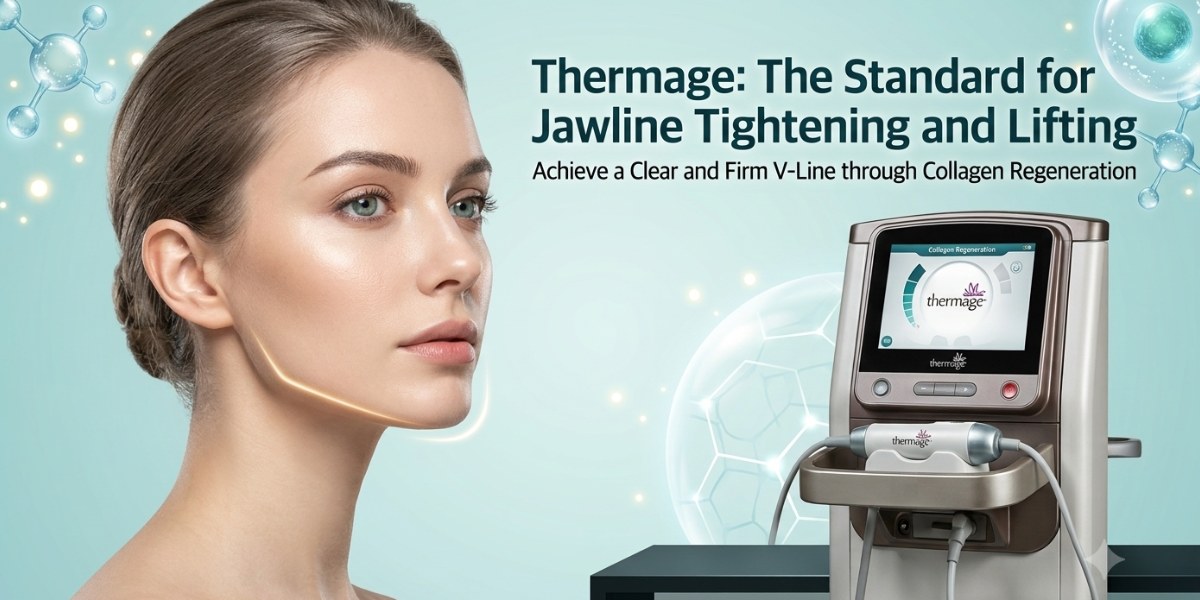
Most patients who research Thermage are really asking one of two questions: will it firm up skin that has started to soften, and is it the right choice over Ultherapy. Both are fair questions, and the honest answers depend on what your skin is actually doing.
This guide explains what Thermage is, what the FLX generation changed, what a session involves, and how it differs from Ultherapy, the treatment it is most often weighed against. For a direct side-by-side, see our Ultherapy vs Thermage guide. It is written for international patients considering treatment in Seoul, and our coordinators can help with appointment questions.
What Thermage Is
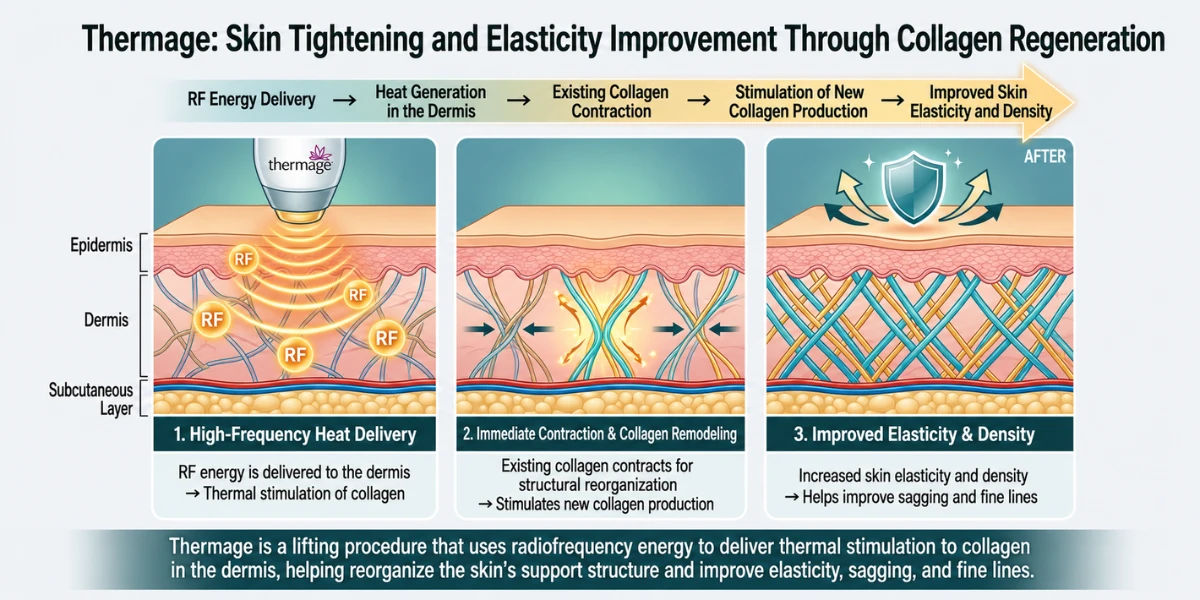
Thermage uses monopolar radiofrequency to heat the deeper layers of the skin in a controlled way. That heat does two things at once. It causes existing collagen to contract immediately, which gives a degree of prompt firming, and it prompts the skin to lay down new collagen over the months that follow. The surface is protected by cooling throughout, so the energy works at depth while the top of the skin stays comfortable.
The result is firmer, smoother, better-quality skin rather than a lift in the surgical sense. Thermage tightens and refines what is there; it does not reposition deeper structures.
What Thermage Addresses
Thermage is best suited to mild to moderate laxity and to skin quality, the early softening and fine creping that comes before significant sagging. Patients most often consider it for:
- A general loss of firmness across the cheeks and face
- Fine wrinkles around the eyes, forehead, and mouth
- Crepey skin, including the eyelid area where some other devices cannot be used
- Overall skin tightening and a smoother surface
It is less suited to heavy, redundant sagging, a dropped jawline or significant laxity that would really call for a deeper lifting approach or surgery. An honest assessment should tell you which category your skin is in before anything begins.
What the FLX Generation Changed
Thermage FLX is the current generation, and the improvements are practical rather than cosmetic. The treatment is faster (a full face that once took around an hour is now often closer to thirty to forty minutes) and more comfortable, thanks to a larger treatment tip and built-in vibration and cooling that take the edge off the sensation. For a treatment whose older versions had a reputation for being uncomfortable, this matters.
How a Session Works
A session begins with an assessment and a plan for the areas to be treated. The treatment tip delivers the radiofrequency in pulses, paired with a cooling burst and gentle vibration with each one. Most patients feel a brief deep heat with each pulse, warm, occasionally sharp, but manageable, and over quickly.
Thermage is typically a single session rather than a course. For most patients, one treatment is the plan, with the result developing gradually afterwards.
What to Expect Afterwards
Downtime is minimal. You may notice mild redness or a feeling of warmth for a few hours to a day, and occasionally slight swelling, but most patients return to normal activity straight away.
Results are gradual. There is often a little immediate tightening from the collagen contraction, but the meaningful change develops over the two to six months that follow as new collagen forms. Results are not permanent (skin continues to age) and typically last in the region of one to two years, varying with your skin and the pace of your own ageing. Because the change is gradual, it tends to look natural rather than sudden.
Thermage FLX Side Effects: What the Manufacturer Reports
Thermage heats the dermis through an intact, cooled surface, and the reactions that follow reflect that. The clearest reference is the Important Safety Information published by Solta Medical, the manufacturer of Thermage FLX. It states that the most commonly reported adverse effect during treatment is mild to moderate pain in the area being treated, and it lists the following as the most commonly reported effects after treatment: mild redness, which it states typically resolves within 24 hours, and swelling, which it states typically resolves within 5 days but can remain for several weeks. How long either lasts varies between individuals.
The same safety information groups a second set of effects under those it describes as occurring “infrequently”. As listed in that document, these are: burns with blister and scab formation where the upper layers of the skin are heated, with a possibility of scarring; skin surface irregularities that may appear up to a month or more after treatment; numbness, tingling or temporary paralysis, which it states typically resolves in a short period but may persist up to several weeks; lumps or nodules under the skin, mainly in the neck area, which it states usually resolve within 1 or 2 weeks; and darkening of the skin, which it states normally resolves within several months. They are listed here so that you know what has been reported. Whether any of these are likely in your case is decided at the clinic after an in-person examination.
Solta’s safety information also sets out who should not have Thermage, and the groups in which its use has not been studied. Treatment is not to be performed on anyone with a cardiac pacemaker, a cardioverter, a defibrillator or any other electrical implant. It states that Solta has not studied the use of the system over skin fillers, in people who are pregnant or breastfeeding, have diabetes, have an autoimmune disease such as lupus, have cold sores or genital herpes, or have epilepsy, in people with cosmetic tattooing or tattoos, or in children. Solta’s Thermage FLX product information also states that the standard face tips should not be used over the eye, and that eye shields should be used for eye treatment, which is one reason eye-area work at Dr. E-Laser is planned separately with the eye tip rather than treated as part of a full-face pass. Bring a list of implants, medications and skin conditions to the consultation, because these are checked before the plan is made.
Thermage and Ultherapy: How They Differ
These two come up together constantly, and the difference is genuinely useful to understand.
Thermage uses radiofrequency and works mainly in the dermis. Its strength is firming, skin quality, and fine wrinkles, and it can treat areas like the eyelids well. Many patients find it the more comfortable of the two.
Ultherapy uses focused ultrasound and reaches deeper, to the SMAS layer that a surgeon addresses in a facelift. Its strength is structural lifting where there is genuine laxity, a softening jawline, brow, or neck. Our guide to Ultherapy in Seoul covers it in full.
In practice they are complementary more often than competing. One treats depth and lift; the other treats surface firmness and quality. A patient with early jowling and crepey, dull skin might do best with both, planned together, which is precisely the kind of decision a proper consultation exists to make, rather than picking a name in advance.
Thermage FLX for the Eye Area and Lower Face: Total Tip 4.0 and Eye Tip 4.0
Thermage FLX is delivered through tips chosen for the region and the thickness of the skin there, which is why the eye area and the lower face are planned as separate passes rather than one continuous treatment.
The Total Tip 4.0 covers the face: tightening of the cheeks and jawline, softening of nasolabial and marionette lines, and overall firmness and texture. The Eye Tip 4.0 is designed for the periorbital region and is used for fine lines and firmness in the lower eyelid area, with eye shields in place, as the manufacturer’s product information states for eye treatment. The standard face tip is not used over the eye. In both cases the radiofrequency is delivered at 6.78 MHz with integrated cooling protecting the surface.
Because the eyelids are one of the places focused ultrasound is not used, patients whose main concern is crepey lower lids are usually talking to the doctor about Thermage FLX first, while jawline laxity may point to Ultherapy Prime or a combination. The tip, the areas and the sequence are set at the consultation.
Is Thermage Right for You?
Thermage suits patients with mild to moderate laxity who want firmer, smoother, better-quality skin without injections or recovery time, and who understand the result builds over months rather than appearing at once. It is a particularly good option for fine wrinkles and crepey skin, including around the eyes.
It is less likely to be the answer if your main concern is significant sagging, which calls for a deeper lifting approach, or if you are expecting a dramatic, immediate change. As with every treatment here, if Thermage is not the right fit, you should be told so, and told what would serve you better. For how dermal firming fits into a broader plan by decade, see our guide to anti-aging treatments in Korea.
Considering skin tightening during a visit to Seoul? You are welcome to share a photo and ask what would suit your skin. Speak with us on WhatsApp.
Planning Thermage Around a Trip to Seoul
Thermage’s minimal downtime makes it well suited to visitors. Because it is usually a single session with little visible after-effect, it fits neatly into a trip, and most patients are comfortable continuing their plans the same day.
The one thing to keep in mind is that you will not leave Seoul with your final result; that develops over the following months. What you leave with is the process underway. Sharing a photo before you travel lets the team prepare and make good use of your time.
Thermage at Dr. E-Laser Dermatology
Dr. E-Laser Dermatology is a laser-focused dermatology practice in Cheongdam, Seoul, one minute from Apgujeong Rodeo Station. With Thermage, the doctor-led approach shows in the planning: assessing whether radiofrequency, ultrasound, or a combination genuinely suits your skin, and treating to a plan built around your face rather than a standard package. Often the most useful advice is about which treatment, or which sequence, will actually serve you.
Our coordinators and staff support you in English, from the first message through the consultation with the doctor to aftercare. Our guide to finding an English-speaking dermatologist in Seoul explains the wider process. Consultations are private and unhurried, and enquiries can be made on WhatsApp.
Pricing and Consultation
Thermage pricing depends on the areas treated and the plan suited to your skin, so it is shared during your consultation rather than as a single fixed figure. This keeps the plan specific to you.
Frequently Asked Questions
How does Thermage work?
It uses monopolar radiofrequency to heat the deeper skin, which contracts existing collagen for some immediate firming and prompts new collagen to form over the following months. The surface is cooled throughout for comfort and protection.
Is Thermage painful?
Most patients feel a brief deep heat with each pulse. The FLX generation adds vibration and cooling that make it noticeably more comfortable than older versions, and the sensation passes quickly.
How many sessions will I need?
Thermage is usually a single session, with the result developing gradually afterwards. Your doctor will advise on timing for any future maintenance.
When will I see results, and how long do they last?
There is often slight immediate tightening, with the meaningful change developing over two to six months as collagen rebuilds. Results are not permanent and typically last around one to two years, varying between individuals.
What is the downtime?
Minimal. Mild redness or warmth for a few hours to a day, occasionally slight swelling. Most patients return to normal activity straight away.
Thermage or Ultherapy, which is better?
Neither is “better”; they do different jobs. Thermage (radiofrequency) firms the dermis and suits skin quality and fine wrinkles; Ultherapy (ultrasound) reaches deeper for structural lifting. They are often combined. The right choice depends on your skin.
Can Thermage be combined with other treatments?
Often, yes, frequently with Ultherapy, and sometimes with boosters or laser, depending on the full picture of your skin. A doctor will plan the sequence and timing.
What are the side effects of Thermage FLX?
The manufacturer’s safety information lists mild redness and swelling as the most commonly reported effects after treatment, and pain during treatment as the most common effect during it. It separately lists burns, surface irregularities, numbness, tingling or temporary paralysis, lumps in the neck area and skin darkening as effects it says occur “infrequently”. How long any of these last varies between individuals, and whether any apply to you is decided at the clinic after an in-person examination.
Is support available in English?
Yes. Our English-speaking coordinators support you from the first message through the consultation to aftercare, and you are welcome to message us on WhatsApp before your visit.
About the Doctor
Dr. Kwangsuk Suh is a board-certified dermatologist and the medical director of Dr. E-Laser Dermatology. He is an adjunct clinical professor of dermatology at Kyung Hee University and Sungkyunkwan University colleges of medicine, and an active member of the Korean Association of Dermatologists, the Korean Association of Clinical Dermatologists, the Korean Society of Hair Restoration Surgery, and the Korean Society for Dermatologic and Cosmetic Surgery.
Arrange a Consultation
If you would like to know whether Thermage (or a combination with Ultherapy) suits your skin, we are glad to help. Share a photo, ask anything, and our English-speaking coordinators will arrange a private consultation. Speak with us on WhatsApp.
This article is for general information and is not medical advice. Outcomes vary between individuals, and a diagnosis and treatment plan are confirmed during an in-person consultation.
Medically reviewed by Dr. Kwangsuk Suh, board-certified dermatologist.
To see how this is done at our clinic, read more about Thermage FLX at Dr. E-Laser.