
Updated October 2026.
Medically reviewed by Dr. Kwangsuk Suh, board-certified dermatologist.
Skin laxity tends to be one of the quieter concerns, the kind patients notice gradually, then research carefully. If you are considering non-surgical lifting in Seoul and have found yourself comparing Ultherapy, Thermage, and Shurink, this guide is written for you.
It explains how Ultherapy works, what a session involves, what results look like and when, and how it differs from the other devices you are likely weighing. If Thermage is the one you keep coming back to, our Ultherapy vs Thermage comparison sets the two side by side. It is written for international patients, and our coordinators can help with appointment questions.
What Ultherapy Is
Ultherapy uses focused ultrasound (high-intensity focused ultrasound, or HIFU) to deliver energy precisely to the deeper structural layers of the skin. The energy creates small, targeted points of thermal injury at depths of 1.5, 3, and 4.5 millimetres, including the SMAS layer: the same layer addressed in a surgical facelift.
The body’s response to those micro-coagulation points is to rebuild. Over the weeks that follow, collagen regenerates and the tissue tightens gradually from within. The skin is not cut, there is no removal of tissue, and the surface remains intact throughout.
At Dr. E-Laser Dermatology, treatment is performed with Ultherapy Prime, the latest generation of the platform. Ultherapy Prime refines the treatment experience with updated imaging and delivery, while working on the same clinically documented principle.
What Ultherapy Addresses
Ultherapy is most suited to patients experiencing early to moderate laxity: skin that has started to lose structure and definition rather than skin that has significantly sagged. Typical concerns include:
- The jawline and jowl area, where definition starts to soften
- The brow, when it has begun to descend
- The neck and décolletage
- Overall facial firmness and contour
- Loose or crepey skin under the chin
It is not a substitute for a surgical facelift. Patients with significant, redundant skin laxity will generally not achieve the degree of change they are looking for from Ultherapy alone, and a doctor should say so clearly before treatment begins.
How a Session Works
A session begins with a full skin assessment and a plan for the lines, depths, and density suited to your anatomy. Because Ultherapy is calibrated to the individual (the number of lines, the depth settings, and the areas treated), this planning stage matters as much as the treatment itself.
The ultrasound transducer is moved systematically across the treatment areas. Most patients describe a sensation of warmth and a brief, intermittent ache as the energy reaches the deeper layers. The intensity varies depending on the area and depth being treated. At Dr. E-Laser Dermatology, patient comfort during the session is managed carefully; this is worth discussing at your consultation, as the experience differs widely between clinics depending on how the treatment is calibrated and how comfort is managed.
A full-face session typically takes between 60 and 90 minutes. Most patients have one session per year, though a partial or maintenance treatment may be appropriate sooner depending on your skin.
What to Expect Afterwards
Recovery is usually straightforward. You may notice mild redness, slight swelling, or a feeling of tenderness in the treated areas, which generally settle within a few hours to a day or two. Most patients return to their usual routine the following day.
Results do not appear immediately, and this is worth knowing. Collagen rebuilds gradually, and meaningful lifting and tightening typically become visible at around two to three months, with the full result developing by six months. Many patients continue to improve beyond that point. Because results are structural and gradual, they also tend to be natural-looking rather than sudden.
A single session is the norm. Maintenance varies; some patients return after 12 to 18 months, others less frequently.
Ultherapy Side Effects: What Is Reported, and for How Long
Ultherapy does not open the skin, so the reactions that follow a session are the kind that come from heat delivered under an intact surface. The most useful reference is the manufacturer’s own Instructions for Use for the Ultherapy PRIME system, which lists the side effects recorded in its clinical evaluation for the brow, under the chin and the neck, and describes them as mild and transient. How long any of these last varies between individuals, and whether any of them are likely in your case is judged at the clinic after an in-person examination.
According to that document, the reactions seen in the clinical evaluation were:
- Redness in the treated area, which the manufacturer states typically settles within a few hours.
- Mild swelling, stated to settle within 3 to 72 hours.
- Welting, a localised line of visible swelling along the treated path, stated to settle within a week.
- Discomfort during the session while energy is delivered, with after-treatment discomfort stated to settle within 2 hours to 2 days, and tenderness to the touch within 2 days to 2 weeks.
- Mild bruising from small blood vessels under the skin, stated to settle within 2 days to 2 weeks.
- Nerve effects, described as transient: numbness where a sensory nerve is inflamed, and local muscle weakness where a motor nerve is inflamed, each stated to settle in 2 to 6 weeks. Tingling, pins and needles, or pain along a nerve are described in the same range. The document states that no irreversible injury to facial nerves was reported in its clinical trials.
The same document lists burns, with or without scarring, as a possibility where treatment technique is incorrect, and it records reports gathered after the product reached the market that were submitted voluntarily, so their frequency cannot be reliably estimated. That post-market list includes blisters, nodules under the skin, fat or volume loss, skin sagging or asymmetry, pigment change and, on the nerve side, numbness or weakness that in some reports lasted for months. These are listed so that you know what has been reported, not as a description of a usual course. The reason a session starts with an assessment and a plan for lines and depth is that anatomy, skin thickness and the areas treated all change what is sensible for your face.
The manufacturer also lists who should not be treated. Its contraindications are open wounds or lesions in the treatment area, severe or cystic acne in the treatment area, and active implants such as pacemakers or defibrillators or metallic implants in the treatment area. It further advises against treating directly over dermal fillers or mechanical implants, over an existing keloid, or near the eyes and eyelids, the thyroid, major vessels and nerves, and it notes that the system has not been evaluated in pregnancy or breastfeeding, in people on anticoagulants, or in several conditions including herpes simplex, autoimmune disease, diabetes, epilepsy and Bell’s palsy. Whether any of these apply to you is decided at the clinic after an in-person examination, so mention fillers, implants, medications and any skin condition at the consultation rather than assuming they do not matter.
Ultherapy, Thermage, and Shurink: An Honest Comparison
These three devices come up together for good reason: they are all non-surgical lifting options, and the right one depends on what your skin is actually doing.
Ultherapy reaches the deepest layer (SMAS) using focused ultrasound. It is the most clinically documented non-surgical lifting device and tends to be the strongest choice when the primary concern is structural laxity: the jawline, brow, and neck. The results build slowly but tend to be meaningful for the right candidate.
Thermage FLX uses monopolar radiofrequency to heat the dermis and deeper tissue. It does not reach the SMAS layer, but it is effective for surface tightening, skin quality, and areas like the eyelids where ultrasound cannot be used safely. Many patients find Thermage more comfortable than Ultherapy. It is often the stronger option when the concern is a general softening of the surface rather than a defined structural lift. Our guide to Thermage FLX in Seoul covers it in full.
Shurink is a Korean HIFU device that works on a similar principle to Ultherapy. It is widely available in Seoul and is typically used at multiple depths. The clinical literature on Shurink is less extensive than on Ultherapy, though both are used routinely in Korean dermatology practice.
In clinical practice, these are often complementary rather than competing options. A patient with early jowling and surface dullness might benefit from both Ultherapy and Thermage in the same plan, one addressing depth, the other surface quality. The choice between them is made during a proper assessment of your skin, not by a fixed menu. Where lifting sits alongside toning and boosters at each stage of life is mapped in our guide to anti-aging treatments in Korea.
Ultherapy Prime by Treatment Area: Jawline, Neck, Brow and Mid-Face
Ultherapy Prime is planned by area rather than as one setting for the whole face, because the depth that matters differs from one region to the next. The transducers used at Dr. E-Laser Dermatology work at 1.5, 3.0 and 4.5 mm, reaching the superficial dermis, the deep dermis and the SMAS layer, and DeepSEE imaging shows those layers in real time so the depth is confirmed before energy is delivered.
Along the jawline and under the chin, the aim is submental tightening and a clearer line where definition has softened. On the neck, the focus is firmness. Across the brow, lines are planned for brow elevation, one of the regions covered in the manufacturer’s clinical evaluation alongside the area under the chin and the neck. In the mid-face, lines are placed to support the cheek and the nasolabial fold.
Which of these areas are included, and how many lines each receives, is decided at the consultation from your own anatomy rather than from a fixed full-face package.
Is Ultherapy Right for You?
Ultherapy works well for patients who want meaningful structural improvement but are not at the stage where surgery is the right answer. If your concern is visible laxity in the jawline, brow, or neck, and your skin still has reasonable tone and elasticity, Ultherapy Prime is likely a strong candidate for your plan.
It is less likely to be the right choice if: your skin laxity is significant and would require surgical correction to address properly; you have very thin skin with little subcutaneous tissue; or your primary concern is surface quality and texture rather than structural lifting.
An honest consultation should tell you which category your skin falls into, including whether Ultherapy is not the right fit and what would serve you better.
Thinking about skin lifting during a visit to Seoul? Share a photo in advance and our English-speaking coordinators will help you plan what is worth considering. Speak with us on WhatsApp.
Planning Treatment Around Your Trip
Ultherapy’s minimal downtime makes it practical for visitors. Most patients are comfortable returning to sightseeing and normal activity the next day, with no visible sign of treatment by the end of the first week.
Because results develop over months rather than days, you will not leave Seoul with your final result in hand, but you will leave with the process underway. Sharing a photo before your visit allows the team to prepare, so your consultation and treatment can move efficiently within the time you have.
International Patients at Dr. E-Laser Dermatology
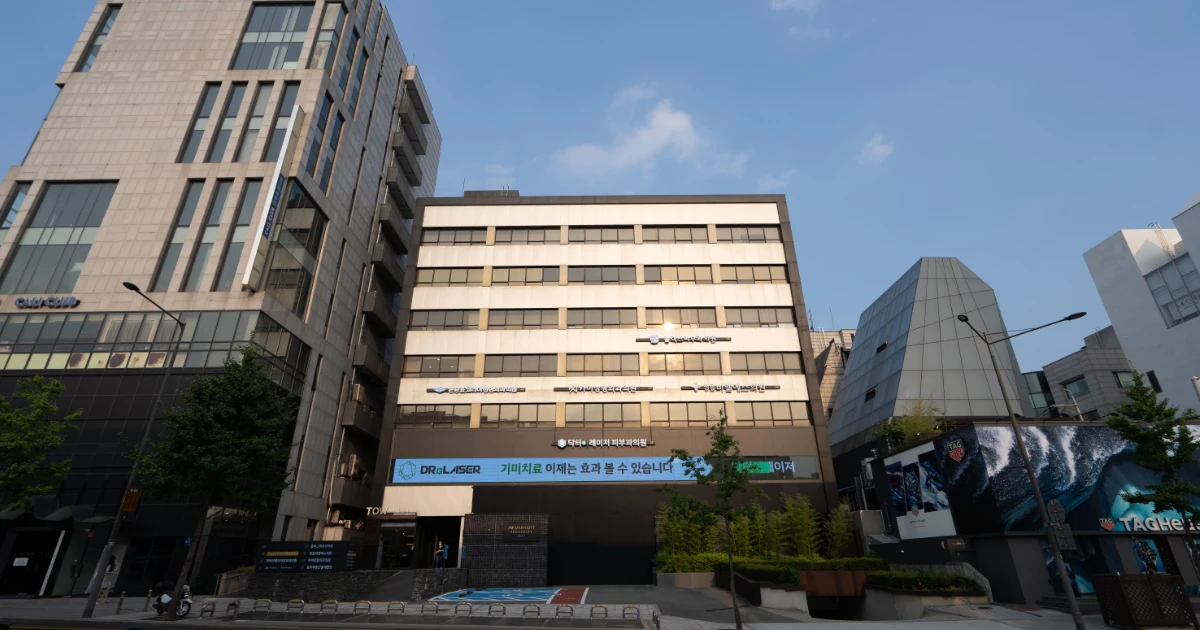
Dr. E-Laser Dermatology is a laser-focused dermatology practice in Cheongdam, Seoul, one minute from Apgujeong Rodeo Station. The approach to Ultherapy Prime, as with every treatment here, is precise calibration based on a proper skin assessment, not a standardised package applied uniformly. Line density, depth, and areas treated are planned around your anatomy.
Our coordinators and staff support you in English, from the first message through the consultation with the doctor to aftercare. Our guide to finding an English-speaking dermatologist in Seoul explains the wider process. Consultations are private and unhurried, and enquiries can be made on WhatsApp.
Pricing and Consultation
Ultherapy pricing depends on the areas treated, the depth settings used, and the line density planned for your skin. Pricing is shared during your consultation, where a doctor can assess what your skin calls for rather than quoting a single fixed figure.
Frequently Asked Questions
Is Ultherapy painful?
Most patients feel warmth and a brief, intermittent ache during the session. Intensity varies by area and depth. Comfort management is part of how the treatment is delivered at our clinic, and worth discussing at your consultation.
How long does a session take?
A full-face session typically takes 60 to 90 minutes, including the preparation and planning stage.
When will I see results?
Results develop gradually. Most patients notice meaningful lifting at two to three months, with the full result visible at around six months.
How long do results last?
Typically 12 to 18 months, though this varies between individuals depending on skin type, age, and the rate of ongoing natural ageing.
How often should I have Ultherapy?
Most patients return once a year for a maintenance session. Some find longer intervals are sufficient. Your doctor will discuss what makes sense for your skin.
What is the downtime?
Minimal. Mild redness and swelling for a day or two; most patients return to normal activity the next day.
What is Ultherapy Prime?
Ultherapy Prime is the latest generation of the Ultherapy platform, with updated imaging and energy delivery. It works on the same focused-ultrasound principle and is the version used at Dr. E-Laser Dermatology.
How does Ultherapy compare to Thermage?
Ultherapy targets deeper structural layers (including the SMAS) using focused ultrasound. Thermage works at the dermis level using radiofrequency, and tends to suit surface quality and areas like the eyes better. They address related but distinct concerns, and can be combined.
What about Shurink?
Shurink is a Korean HIFU device working on a similar principle. It is commonly used in Seoul. The right device for your skin depends on your anatomy and your concern, which is what a consultation is for.
Can Ultherapy be combined with other treatments?
Often, yes. It is frequently combined with Thermage, collagen boosters such as Juvelook, or RF microneedling such as Potenza, depending on the full picture of your skin. A doctor will plan the right sequence and timing.
What are the side effects of Ultherapy?
The manufacturer’s Instructions for Use lists redness, mild swelling, welting, discomfort and tenderness, mild bruising and transient nerve effects such as numbness or tingling as the side effects seen in its clinical evaluation, and describes them as mild and transient. Burns and longer-lasting nerve effects have been reported after market release. How long any reaction lasts varies between individuals, and whether any of these apply to you is decided at the clinic after an in-person examination.
Is support available in English?
Yes. Our English-speaking coordinators support you from the first message through the consultation to aftercare, and you are welcome to message us on WhatsApp before your visit.
About the Doctor
Dr. Kwangsuk Suh is a board-certified dermatologist and the medical director of Dr. E-Laser Dermatology. He is an adjunct clinical professor of dermatology at Kyung Hee University and Sungkyunkwan University colleges of medicine, and an active member of the Korean Association of Dermatologists, the Korean Association of Clinical Dermatologists, the Korean Society of Hair Restoration Surgery, and the Korean Society for Dermatologic and Cosmetic Surgery.
Arrange a Consultation
If you would like to know whether Ultherapy Prime, or a combination approach, suits your skin, we are glad to help. Share a photo, ask anything, and our English-speaking coordinators will arrange a private consultation. Speak with us on WhatsApp.
This article is for general information and is not medical advice. Outcomes vary between individuals, and a diagnosis and treatment plan are confirmed during an in-person consultation.
Medically reviewed by Dr. Kwangsuk Suh, board-certified dermatologist.
To see how this is done at our clinic, read more about Ultherapy Prime at Dr. E-Laser.