
Medically reviewed by Dr. Kwangsuk Suh, board-certified dermatologist.
Ultherapy vs Thermage is the comparison nearly every lifting patient arrives with, and it is usually asked as a which-is-better question. The honest answer is that neither wins, because they are different instruments doing different jobs at different depths. The useful question is which one describes your skin, and sometimes the answer is both, staged sensibly over time.
This guide sets out how each works, which concerns each is suited to, and how a doctor decides between them. It is written for international patients considering treatment in Seoul, and our coordinators can help with appointment questions.
The Short Answer
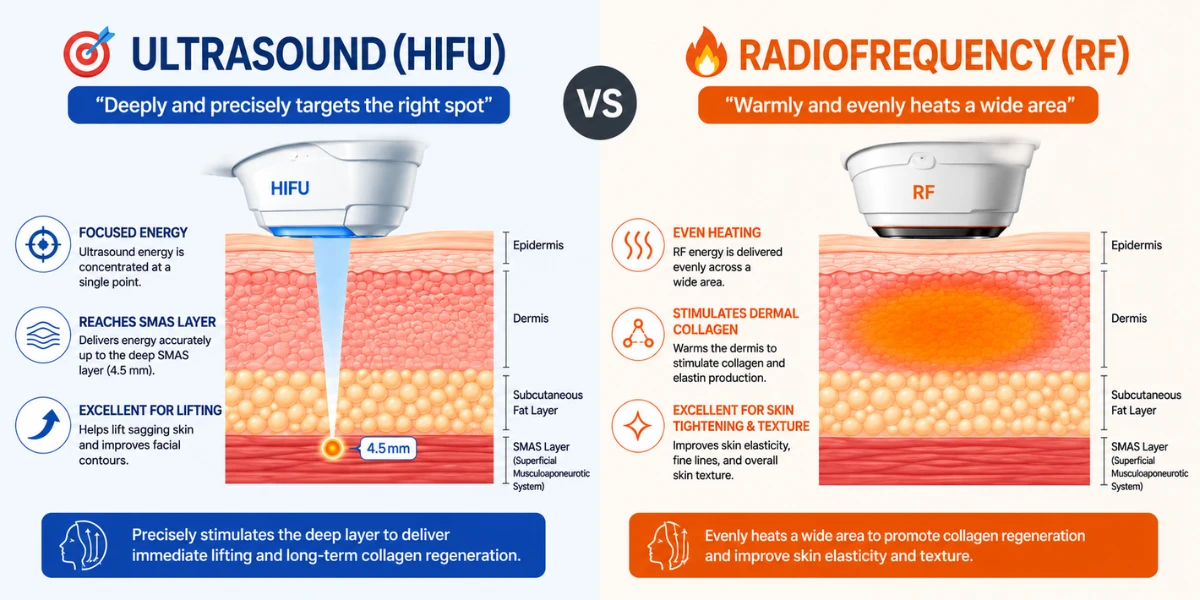
Ultherapy uses focused ultrasound to reach the deep structural layer of the face (the SMAS), so it suits genuine sagging: a softening jawline, jowls, a descending brow, a loosening neck. Thermage uses monopolar radiofrequency to firm the dermis, so it suits surface laxity, fine wrinkles, and crepey skin quality, including around the eyes. Deep structure points to ultrasound; dermal firmness and texture point to radiofrequency. Some patients need one, and many benefit from both, planned in sequence. The rest of this guide explains how to tell which describes you.
How Each One Works
Ultherapy Prime: ultrasound, depth, and lift
Ultherapy delivers high-intensity focused ultrasound to precise depths of 1.5, 3.0, and 4.5 millimetres, including the SMAS layer, the same layer addressed in a surgical facelift. Small points of thermal coagulation trigger collagen rebuilding, and the tissue tightens gradually from within over two to three months, with the fuller result by around six. At Dr. E-Laser Dermatology it is performed with Ultherapy Prime, the current generation of the platform, and patients researching Ultherapy Prime in Korea will find the full detail in our guide to Ultherapy Prime in Seoul.
Thermage FLX: radiofrequency, dermis, and firmness
Thermage delivers monopolar radiofrequency that heats the dermis in a controlled way while the surface is cooled. Existing collagen contracts for a degree of prompt firming, and new collagen forms over the following two to six months. Because it works in the dermis rather than at the SMAS, its strength is skin quality: firmness, fine wrinkles, and crepey texture, and it can treat the eyelid area, where focused ultrasound is not used. Patients comparing options for Thermage FLX in Seoul can read our full Thermage FLX guide.
Ultherapy vs Thermage at a Glance
| Ultherapy Prime | Thermage FLX | |
|---|---|---|
| Energy | Micro-focused ultrasound | Monopolar radiofrequency |
| Working depth | Down to the SMAS layer (4.5 mm) | Mainly the dermis |
| Primary role | Structural lift for sagging | Dermal firming, texture, fine wrinkles |
| Typical areas | Jawline, jowls, brow, neck | Cheeks, around the eyes, crepey skin |
| Sensation | Warmth with a brief deeper ache | Brief deep heat, with cooling and vibration |
| Downtime | Minimal, mild redness or swelling for a day or two | Minimal, usually a few hours of warmth or redness |
| Results timeline | Visible from two to three months, fuller by six | Gradual over two to six months |
| Typical rhythm | Single session, often reviewed yearly | Single session, often every one to two years |
A skin tightening comparison chart is useful for orientation, but the deciding factor in Ultherapy vs Thermage is not on it: the depth at which your skin has actually changed, which is read in an assessment, not in a mirror.
Which One for Sagging, Jowls, and the Jawline
When the change is structural (the jawline losing its line, jowls forming, the brow descending, the neck loosening), the concern sits deeper than the dermis, and ultrasound is the tool built to reach it. For these patients Ultherapy is usually the stronger candidate, because it treats the layer where the laxity lives. It rewards patience: the lift builds over months and tends to look natural rather than sudden. If laxity is significant and redundant, an honest consultation should also say when neither device is enough and surgery is the truthful answer.
Which One for Surface Laxity, Texture, and the Eye Area
When the skin itself has softened (fine wrinkles, creping, a general loss of firmness across the cheeks) while the underlying structure still holds, the concern sits in the dermis, and radiofrequency is designed for exactly that. Thermage is usually the more appropriate candidate here, and it holds a particular place for the eye area, where it can treat crepey eyelid skin that ultrasound cannot. The ultrasound vs radiofrequency lifting distinction sounds technical, but it maps quite neatly onto what you see: contours moving points to ultrasound, surface quality fading points to radiofrequency.
Combining Ultherapy and Thermage
Because the two treat different layers, they pair logically rather than compete. A patient with early jowling and crepey, finely wrinkled skin has two problems at two depths, and combining Ultherapy and Thermage addresses each where it lives. In practice the treatments are staged rather than performed in one sitting, with the doctor setting the order and the interval around your skin and your travel dates. For these patients the Ultherapy vs Thermage framing is the wrong question; the answer is a sequence, not a choice. A combination should always emerge from an assessment, never arrive as a default package.
Where Shurink and the Other Devices Fit
Ultherapy and Thermage are not the whole category. Shurink Universe, the widely used Korean HIFU device, works on the same ultrasound principle at a generally gentler intensity, covered in our Shurink Universe guide, and laser-based tightening options exist alongside it. Our non-surgical skin tightening guide maps the full set and how a doctor chooses between them.
Weighing lifting options for a visit to Seoul? Share a photo and our English-speaking coordinators will help you plan what is worth considering. Speak with us on WhatsApp.
Deciding at Dr. E-Laser Dermatology
Dr. E-Laser Dermatology is a laser-focused dermatology practice in Cheongdam, Seoul, one minute from Apgujeong Rodeo Station. Both devices are offered here, Ultherapy Prime and Thermage FLX, and that changes the nature of the advice: when a clinic holds both, the recommendation can follow your skin rather than the equipment list. Reading where laxity actually sits and matching Ultherapy vs Thermage, or a staged combination, to it is precisely the judgement a proper consultation exists to make.
Our coordinators and staff support you in English, from the first message through the consultation with the doctor to aftercare. Our guide to finding an English-speaking dermatologist in Seoul explains the wider process.
Pricing and Consultation
Pricing for each treatment depends on the areas treated and, for Ultherapy, the line count planned for your skin, so it is confirmed at your consultation rather than quoted as one fixed figure. Our guide to skin treatment costs in Seoul explains how pricing works for international patients, and enquiries can be made on WhatsApp.
Frequently Asked Questions
Is Ultherapy better than Thermage? Neither is better in any universal sense; they work at different depths. Ultrasound (Ultherapy) suits structural sagging; radiofrequency (Thermage) suits dermal firmness and texture. The right one is the one that matches where your skin has changed.
Can I have both Ultherapy and Thermage? Often, yes. Because they treat different layers, many plans stage the two, with the doctor setting the order and interval. This is decided at assessment, not assumed in advance.
Which lasts longer, Ultherapy or Thermage? Both develop over months and neither is permanent, since skin keeps ageing. Ultherapy results are commonly reviewed at around twelve to eighteen months, Thermage at around one to two years, though this varies widely between individuals.
Which is more comfortable? They feel different. Ultherapy produces warmth with a brief, deeper ache; Thermage FLX pairs each pulse with cooling and vibration, which many patients find easier. Comfort is managed carefully during both, and it is worth discussing at your consultation.
Is support available in English? Yes. Our English-speaking coordinators support you from the first message through the consultation to aftercare, and you are welcome to message us on WhatsApp before your visit.
About the Doctor
Dr. Kwangsuk Suh is a board-certified dermatologist and the medical director of Dr. E-Laser Dermatology. He is an adjunct clinical professor of dermatology at Kyung Hee University and Sungkyunkwan University colleges of medicine, and an active member of the Korean Association of Dermatologists, the Korean Association of Clinical Dermatologists, the Korean Society of Hair Restoration Surgery, and the Korean Society for Dermatologic and Cosmetic Surgery.
Arrange a Consultation
If you would like to know whether Ultherapy, Thermage, or a staged combination suits your skin, we are glad to help. Share a photo, ask anything, and our English-speaking coordinators will arrange a private consultation. Speak with us on WhatsApp.
This article is for general information and is not medical advice. Outcomes vary between individuals, and a diagnosis and treatment plan are confirmed during an in-person consultation. Medically reviewed by Dr. Kwangsuk Suh, board-certified dermatologist.